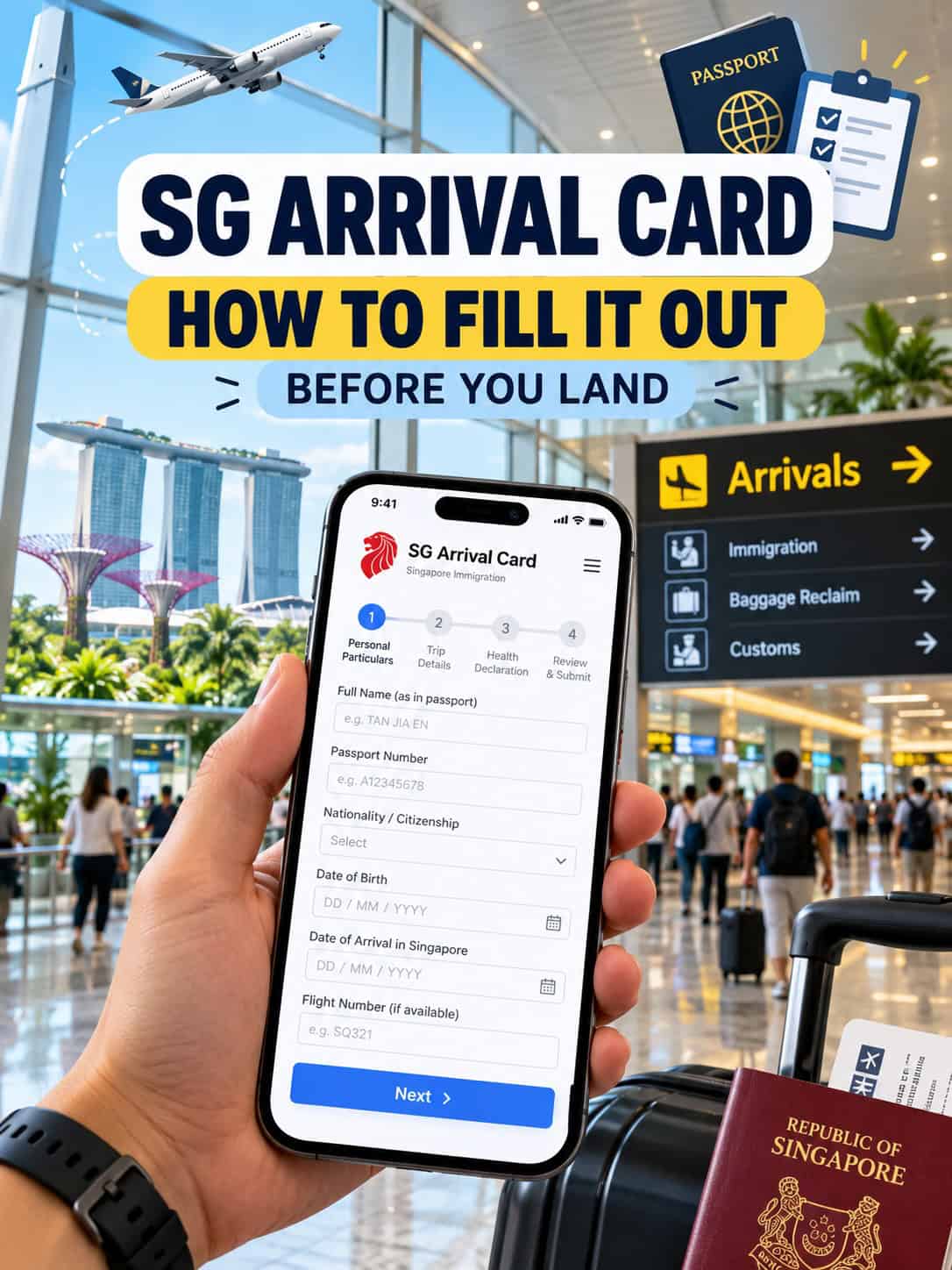
The Singapore arrival card (the SG Arrival Card, or SGAC) is the free online form almost every traveler must submit before entering Singapore. It replaced the paper disembarkation card, which ICA stopped using from 27 March 2020. It takes a few minutes, and this guide explains who needs it, when to submit it, how to fill it out and how to avoid paid scam sites.
Singapore Arrival Card at a Glance
| Question | Answer |
|---|---|
| What is it? | The electronic version of the paper arrival card, with arrival details and a health declaration |
| Cost | Free of charge |
| When to submit | Within three days before arrival, including the day of arrival |
| Where to submit | The official SG Arrival Card e-Service on the ICA website or the MyICA mobile app |
| Is it a visa? | No |
| Who is exempt | Travelers transiting without seeking immigration clearance, and residents entering via the Woodlands or Tuas checkpoints |
Who Needs the Singapore Arrival Card
Nearly all travelers entering Singapore need to submit the SG arrival card, regardless of nationality. Foreign visitors submit arrival information and a health declaration, while Singapore citizens, permanent residents and long-term pass holders submit a health declaration only. The main exceptions are passengers transiting through Changi without seeking immigration clearance, and residents entering through the Woodlands or Tuas land checkpoints. If you are flying in and leaving the airport, assume you need one.
When to Submit the SG Arrival Card
Submit within three days before arrival, counting the day of arrival itself, so if you land on a Thursday, the earliest you can file is the Tuesday before. It is worth doing this the night before you fly rather than at the gate, since it needs a working internet connection and a few minutes of attention. After a successful submission you receive an acknowledgement email at the address you declared.
How to Fill Out the SG Arrival Card Online
There are two official channels: the SG Arrival Card e-Service on ICA’s website, or the MyICA mobile app, which is free on the App Store and Google Play and can save your profile to speed up future trips. Both ask for the same basics: passport and personal details, travel information and an electronic health declaration. The Singapore digital arrival card is also not a visa, and you still present your travel document to the officer at the immigration counter. First-time foreign visitors, and anyone returning on a different passport, show that passport at immigration, and children under six cannot use the automated lanes.
ICA has also rolled out an enhanced version on the MyICA app from 30 September, with passport-scan autofill, and the web version was already updated. The form now comes in 19 languages, and MyICA users need the latest version of the app to submit it. See our breakdown of the enhanced arrival card for what changed. If several people are traveling together on one trip, ICA’s group submission option lets you file for the group, and if your health status changes after you submit, use the Update SGAC feature in the e-Service. A group submission covers a single trip, while an individual submission can include up to three trips, which helps if you leave and come back within a few days, for example on a day trip to Johor Bahru or Batam.
Avoiding SG Arrival Card Scam Sites
Search for the SG Arrival Card and you will find third-party sites offering to submit the form for a fee. ICA does not support or endorse fee-charging services, and says they are not affiliated with it. The real form is free on ICA’s own e-Service or the MyICA app, so there is no reason to pay anyone to fill it out for you.
False Declarations and the Health Section
The health declaration exists for disease control, to guard against importing diseases of concern and protect people living in Singapore. ICA says it is an offence to submit a false declaration and that offenders may be prosecuted under the Infectious Diseases Act, so answer the health questions honestly rather than rushing through them.
Frequently Asked Questions About the SG Arrival Card
Do I need a Singapore arrival card?
Almost every traveler entering Singapore does. The exceptions are travelers transiting or transferring without seeking immigration clearance, and residents entering through the Woodlands or Tuas land checkpoints.
How much does the Singapore arrival card cost?
Nothing. Submission is free of charge. Sites that charge a fee to submit it for you are not affiliated with ICA.
When can I submit the SG arrival card online?
Within three days before arrival, counting the day of arrival itself. For example, if you land on Thursday, you can submit from Tuesday.
Is the Singapore digital arrival card a visa?
No. The SG Arrival Card is not a visa. You still need to meet Singapore’s entry requirements and present your travel document at the immigration counter.
Can I submit one card for my whole family?
ICA offers a group submission option for people traveling to Singapore together on one trip. It does not cover multiple trips, but an individual submission can include up to three trips.
What if my health status changes after I submit?
Use the Update SGAC feature in the e-Service to update the health declaration.
Do I need to print the Singapore arrival card?
ICA’s guidance describes a fully electronic process and an acknowledgement email after a successful submission. Keep that email and your travel document handy when you arrive.
What happens if I make a false declaration?
ICA says it is an offence to submit a false declaration and that offenders may be prosecuted under the Infectious Diseases Act, so answer the health questions honestly.
Bottom Line: Singapore Arrival Card
File the Singapore arrival card directly through ICA’s e-Service or the MyICA app, in the three days before you land, and ignore any site that asks for a processing fee. If you still need to sort out your visa status, our Singapore visa guide covers who needs one and how to apply, our Changi Airport terminal guide helps with the arrival itself, and getting around Singapore covers what comes next. For safety tips on arrival, see Is Singapore Safe for Tourists?