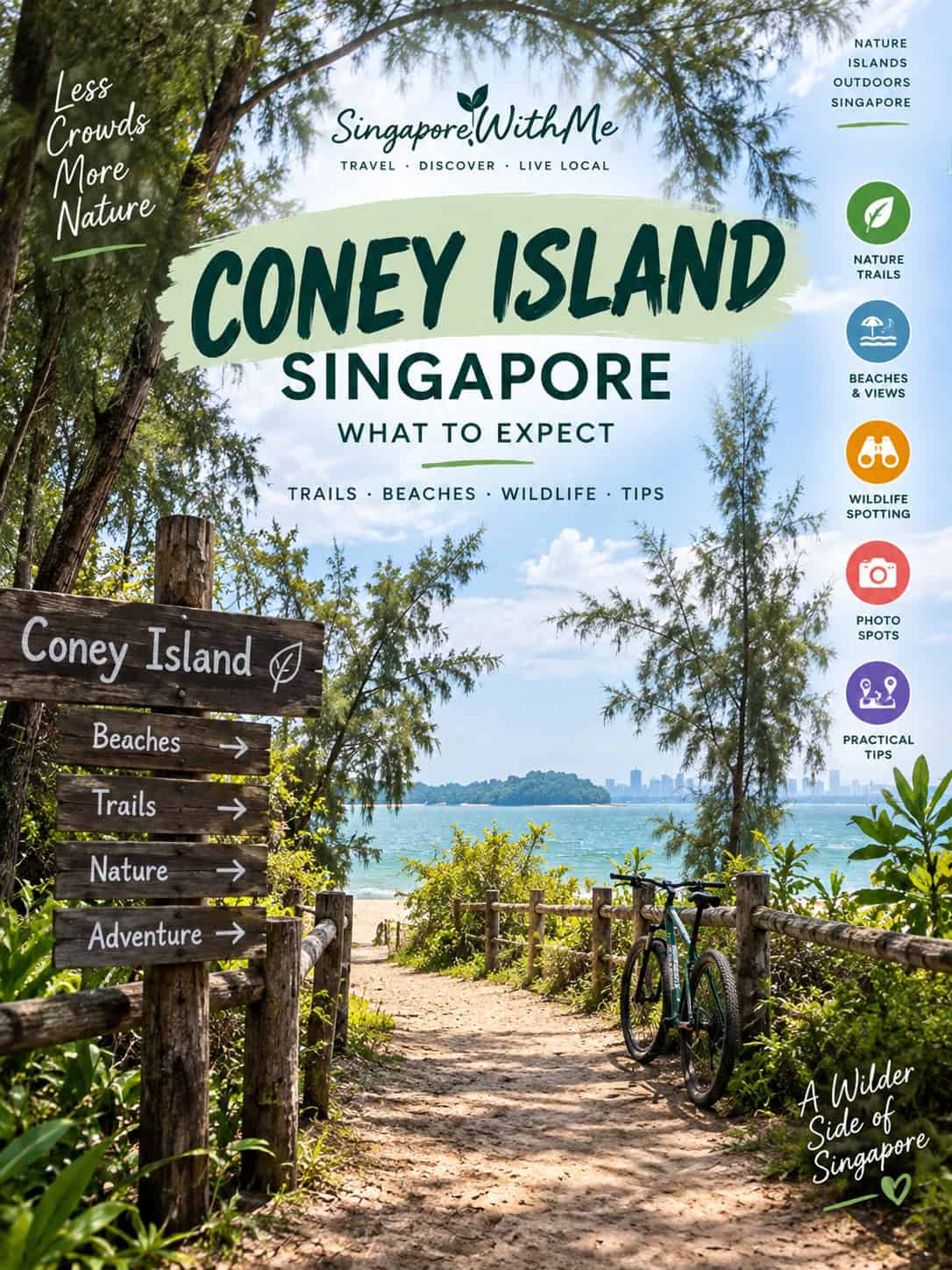
Coney Island Singapore (Pulau Serangoon) is an 81-hectare nature park on Singapore’s northeast coast. Admission is free and both park entrances open 7am–7pm daily. The island has five natural beach areas, coastal forest, mangroves and designated walking and cycling tracks. NParks recommends a 3.6km self-guided walk taking about two hours. Bring drinking water and closed shoes: there are no shops or piped drinking-water supplies on the island.
From Private Resort to Nature Park
Coney Island Singapore was formerly called Pulau Serangoon; the island has a history of private ownership and reclamation before becoming part of Singapore’s public park network. NParks officially opened Coney Island Park on 10 October 2015, and the present nature park covers 81 hectares. Its historical buildings are not modern tourist facilities: in particular, Haw Par Beach Villa is closed to entry. Focus a visit on the accessible nature trails rather than any former resort accommodation.
What’s There Now at Coney Island Singapore
At Coney Island Singapore there are five themed beach areas, A to E, connected to designated trails through casuarina woodland and coastal habitats. The mangrove boardwalk and estuary provide places to watch for tree-climbing crabs, mudskippers and tidal wildlife, although sightings are not guaranteed. For planning, use NParks’ 3.6km nature trail (about two hours) rather than treating the approximately two-kilometre beach stretch as the distance of the recommended walking route. The beaches are not advertised as supervised swimming beaches.
More than 80 resident and migratory bird species have been recorded at Coney Island Park, including the Common Flameback and Baya Weaver. Beach Area C has the only two wild Paku Raja cycads in mainland Singapore. The mangroves are also habitat for mudskippers and tree-climbing crabs. Keep wildlife encounters as possibilities, not promises: do not plan an itinerary around guaranteed otter sightings or approaching any wild animals.
Coney Island Nature Park: What to See
| Stop | What visitors can see | Practical note |
|---|---|---|
| Beach areas A–E | Natural coastal scenery, driftwood and casuarinas | Photo stops, not lifeguarded swimming areas |
| Mangrove boardwalk | Mangrove plants and tidal habitat | Remain on the constructed path |
| Estuary | Possible mudskippers, tree-climbing crabs and mud lobsters | Sightings vary with tide and weather |
| Casuarina Exploratory | Nature-play features from repurposed timber | Supervise children |
| Beach Area C | Rare Paku Raja cycads nearby | Observe without touching vegetation |
| West Promenade | Views towards Pulau Ubin and Pasir Gudang | Convenient first stop from West Entrance |
NParks’ recommended self-guided walking route is 3.6km and takes about two hours. Allow extra time for photography, breaks and any additional side paths. NParks volunteers also lead guided Ecolife walks of about two hours (2 to 3km) on selected Saturday mornings in March, June, September and November, covering the park’s wildlife and history; registration opens one month before each session.
Getting There and Around
Coney Island Singapore how to get there: the West Entrance is near Punggol Point Walk and Punggol Promenade; the East Entrance is beside Lorong Halus Wetland. Punggol Coast MRT (NE18) is the nearest station, followed by a coastal walk towards the West Entrance; allow approximately 15–30 minutes depending on the chosen path and current works. Punggol Coast is only one stop beyond Punggol on the North East Line (NE17 to NE18), and buses 84G and 84W from Punggol Interchange also call at Punggol Coast Station. The old bus 84 to Punggol Road End no longer runs. There is no carpark on the island, and the nearest one, beside Punggol Settlement, is shut for the Punggol Point Park works covered below, so come by MRT. Bicycle parking is available at both gates.
Coney Island cycling at Coney Island Singapore is permitted on designated park tracks, reached from either bridge. There are no visitor cars or internal shuttle buses. The surface can be rugged, so ride slowly near pedestrians and use a suitable bicycle. Cycling is a way to explore the island, but it is not a substitute for visiting narrow beach and mangrove paths on foot. Exit by 7pm.
Punggol Coney Island: Transport and Entrances
| Starting point | Route | Planning detail |
|---|---|---|
| Punggol Coast MRT (NE18) | Walk via Punggol Promenade to West Entrance | Allow 15–30 minutes depending on route/access |
| Punggol MRT and bus interchange | Train one stop to Punggol Coast (NE18), or bus 84G/84W; then walk to the West Entrance | Same walk as from Punggol Coast |
| Lorong Halus Wetland | Enter via East Bridge | Alternative end-to-end route |
| Car | Punggol Settlement carpark is closed until 31 December 2027; come by MRT | No carparking within the nature park |
| Bicycle | Use either entrance and designated trails | Rent or arrange the bike off-island |
Coney Island Walking Versus Cycling
| Activity | Time to allow | Best for |
|---|---|---|
| NParks 3.6km self-guided walk | About 2 hours | Nature, beaches, birdwatching |
| Short West Entrance nature visit | 45–90 minutes | Shorter coastal excursion |
| Ride designated cycling tracks | Allow 1–2 hours with stops | Confident riders on uneven tracks |
Walking and cycling times at Coney Island Singapore are estimates inside the park. Add public-transport travel time from your starting location. Entry costs S$0; bike hire, public transit and food outside the park are separate.
Practical Tips for Coney Island Singapore
Coney Island Park opening hours are 7am–7pm daily. The East and West ends have wheelchair-accessible and stroller-friendly sections, but some internal tracks have rugged ground and can be unsuitable for visitors with limited mobility or young children. Wear long trousers and covered shoes against insects such as sandflies, carry water, and stay on designated routes. NParks warns of wild boars, territorial stray dogs and box jellyfish in coastal waters. Do not plan swimming or wading, and leave the park before sunset and gate closing.
At Coney Island Singapore, do not feed macaques or carry exposed plastic bags and water bottles that can attract their attention; keep food and drinks inside a closed bag instead. Camping, fishing, entering Haw Par Beach Villa and leaving designated trails are prohibited. Take rubbish back to the mainland.
Coney Island Singapore: Simple Two-Hour Walk
- 7:30am: Enter from the West gate and walk the West Promenade.
- 7:45am: Follow the casuarina tracks and stop at a designated beach viewpoint.
- 8:15am: Visit accessible mangrove boardwalk and estuary areas, looking for shore wildlife.
- 8:45am: Continue the signposted nature trail towards the eastern end or turn back if needed.
- 9:30am: Leave via an appropriate gate; continue to Punggol for breakfast or lunch.
This Coney Island Singapore schedule is an illustrative self-guided walk, not a guided departure. Keep an offline map or a travel eSIM on your phone and follow any on-site diversions.
Important Access Note: Coney Island and Punggol Point Park Are Different Parks
Visitors to Coney Island Singapore should know that Punggol Point Park and its adjacent carpark are subject to a major upgrading closure from 11 August 2026 to an expected 31 December 2027. That restriction is not a blanket closure of Coney Island Park. NParks continues to list Coney Island Park with two entrances and normal 7am–7pm hours. The park’s carpark closes with it, while its toilets stay open. Follow posted diversions on the western approach and do not enter fenced-off sections of Punggol Point Park.
Bottom Line: Coney Island Singapore
Coney Island Singapore is a free nature walk rather than a beach resort. Plan two to three hours for the 3.6km trail and optional beach detours, bring water and enclosed shoes, and exit before the 7pm closure. The Punggol Point Park upgrading closure is separate from the Coney Island nature park and should not be treated as proof that the island itself is shut. For a more developed waterfront experience, continue with our Punggol Waterway Park guide.
For another island nature trip, see our guide to How to Get to Pulau Ubin: Bumboat Guide.
FAQ: Coney Island Singapore
Is Coney Island Singapore free?
Yes. The two nature park entrances have no admission charge.
When is Coney Island Park open?
Daily from 7am to 7pm. Finish your route before the gates close.
How do I get to Coney Island from Punggol MRT?
Ride the North East Line one stop to Punggol Coast (NE18) and walk to the West Entrance. Buses 84G and 84W from Punggol Interchange also stop at Punggol Coast Station; the old bus 84 to Punggol Road End no longer runs.
Is Punggol Coast the closest MRT?
Yes. Punggol Coast (NE18) is the nearest station; continue on foot to the West Entrance, allowing roughly 15–30 minutes depending on the route.
Can I cycle on Coney Island?
Yes, on designated park tracks. Some surfaces are rugged, so cycle carefully and arrange a bicycle before entering the island.
How long is the Coney Island nature walk?
The NParks self-guided route is 3.6km and takes approximately two hours.
Can I swim at Coney Island beaches?
The natural beaches are not promoted as lifeguarded swimming areas. Box jellyfish have been spotted nearby, so swimming or wading is not a recommended activity.
Is Coney Island suitable for strollers?
Both ends have stroller-friendly sections, but rugged internal tracks may be unsuitable for some strollers or visitors with mobility restrictions.
Is the entire Coney Island Park closed until 2027?
No. A separate upgrading closure affects neighbouring Punggol Point Park. The current NParks Coney Island listing retains two entrances and 7am–7pm hours.