West of the bay’s glass towers, the Civic District is Singapore’s colonial-era core — a cluster of 19th and early-20th-century buildings, a historic open field, and a handful of museums housed in former government buildings, all within a comfortable walking loop. This Civic District walking guide is a slower, architecture-and-history half-day compared to Marina Bay’s headline attractions, and it pairs naturally with a Merlion Park visit since the two sit right next to each other.
National Gallery Singapore
The centerpiece of the district, National Gallery Singapore occupies two connected colonial landmarks — the former Supreme Court (1939) and the former City Hall (1929) — joined by a covered courtyard. Inside is the world’s largest public collection of modern Southeast Asian art, spanning the 19th century to today. Admission is free for Singapore citizens and permanent residents; other visitors pay S$20 for general admission or S$30 for an All Access ticket covering special exhibitions. The gallery is open daily, 10am–7pm, with last admission at 6:30pm. Budget at least 2–3 hours if you want a proper look rather than a quick pass-through — it’s a genuinely large building.
The Padang
Directly in front of the old City Hall building sits the Padang, an open field that’s been used for cricket since the 1830s and still hosts the Singapore Cricket Club at its southern end. It’s freely accessible to walk across at any time, and it’s where National Day Parade rehearsals and major public events still take place today — genuinely still in active civic use rather than a preserved-but-empty historic space.
St Andrew’s Cathedral
A short walk from the Padang, this Anglican cathedral was completed in 1862 in neo-Gothic style and remains free to enter daily. One detail worth knowing before you go: the interior’s smooth white plaster finish was historically achieved using “Madras chunam,” a traditional technique mixing lime plaster with egg whites, sugar, and coconut husks — a small but genuinely interesting piece of colonial-era building craft rather than just another white church interior.
The Arts House (Old Parliament House)
Built in 1827, this is Singapore’s oldest surviving government building, and it now functions as a multi-arts venue with occasional free exhibitions and performances rather than a government seat. Even without an event on, the exterior alone — one of the district’s most distinctive colonial facades — is worth the short detour from the riverfront.
Victoria Theatre and Concert Hall
Recently reopened after a major restoration, this riverfront landmark’s clock tower is one of the most recognizable colonial silhouettes along the river. The Concert Hall inside is regarded as one of Singapore’s best acoustic performance venues, so if a show happens to be scheduled during your visit, it’s worth checking — otherwise the building itself is a solid photo stop on the walk between the Padang and the river.
Asian Civilisations Museum
On the riverfront at Empress Place, this museum occupies a Palladian-style building completed in 1864 and focuses on the history and material culture connecting Singapore to the wider Asian trade and migration networks. Its strongest single collection comes from a shipwreck salvage — the Tang shipwreck finds, one of the most significant troves of 9th-century Chinese ceramics ever recovered from a single site. Adult admission runs around S$20 for non-residents, generally free for citizens and permanent residents, broadly in line with National Gallery’s pricing tier since both fall under Singapore’s National Heritage Board.
Guided walking tours cover much of this same ground if you’d rather have the history explained on the spot than read it off a plaque — several local operators run 2-to-3-hour Civic District walking tours through National Gallery Singapore, the Padang, and the riverfront landmarks, which can be worth the cost if you’re short on research time or traveling with kids who do better with a live storyteller than a self-guided route.
Raffles’ Landing Site
At the north bank of the Singapore River near Cavenagh Bridge, a statue marks the approximate spot where Stamford Raffles is said to have landed on January 29, 1819. The bronze statue standing here today is a copy — the original marble version, unveiled in 1887, now lives inside the National Museum, moved to protect it from the elements.
A Rough Civic District Walking Route
- Start at City Hall MRT. Exit A puts you right by St Andrew’s Cathedral and the Padang; Exit E leads toward Victoria Theatre and the Asian Civilisations Museum.
- Walk the Padang and into National Gallery Singapore — budget the bulk of your morning here if art and architecture are the priority.
- Head toward the river via the Arts House and Victoria Theatre, ending at Asian Civilisations Museum and Raffles’ Landing Site.
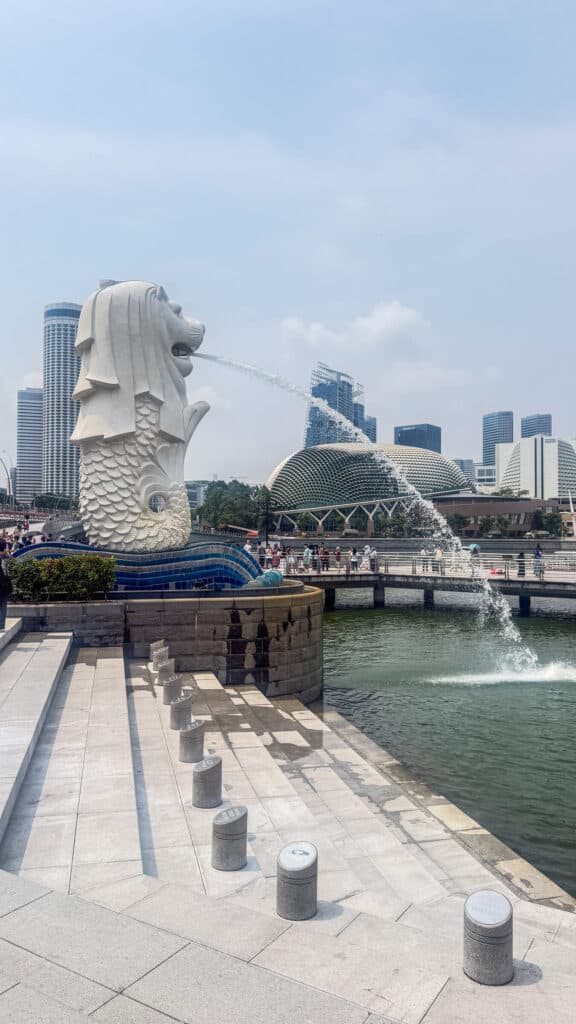
- Finish at Merlion Park, a five-minute walk further along the riverfront, to close the loop with the district’s most photographed view.
Getting There and Best Time to Visit
City Hall MRT sits directly in the middle of the district, with Raffles Place and Esplanade stations both walkable from the river end. The whole loop is genuinely comfortable to walk, but the 11am–3pm stretch makes outdoor walking between buildings unpleasant in Singapore’s heat — early morning or late afternoon into evening works far better, and it also means better light for photos of the colonial facades.
For how the Civic District fits into a wider Marina Bay itinerary, see this site’s Marina Bay travel guide. If you’re finishing your walk at the waterfront, this site’s Merlion Park guide covers the best photo timing for the statue right next door.
Frequently Asked Questions
How long does the Civic District walk take?
Walking between all the landmarks without going inside any museum takes about 2 hours. Add National Gallery Singapore properly and it becomes a genuine half-day, especially with a stop at Merlion Park to finish.
Is the Padang free to visit?
Yes — it’s an open public field with no admission fee or gate, accessible any time.
Is National Gallery Singapore free?
Free for Singapore citizens and permanent residents. Other visitors pay S$20 for general admission or S$30 for an All Access ticket covering special exhibitions.
What’s the closest MRT station to the Civic District?
City Hall MRT sits in the middle of the district, with direct access to the Padang and National Gallery from Exit A.
Bottom Line
The Civic District is the slower, history-focused counterpart to Marina Bay’s glass-and-neon side of the water, and it’s worth at least half a day if you actually want to see National Gallery Singapore properly rather than rush past it. Walk it early morning or late afternoon, and finish at Merlion Park to end on the district’s best photo.
For more nearby, see our guide to ArtScience Museum: Tickets and Current Exhibitions.
Pingback: Singapore Events November 2026: Deepavali and the Singapore Writers Festival - Singapore With Me
Pingback: Singapore Events January 2026: Singapore Art Week and ART SG - Singapore With Me
Pingback: Singapore Events May 2026: SIFA, HeritageFest, and Tulipmania - Singapore With Me
Pingback: Singapore Events August 2026: National Day and Singapore Night Festival - Singapore With Me
Pingback: Singapore Events October 2026: F1 Grand Prix and Halloween
Pingback: Singapore Events December 2026: Christmas and Countdown
Pingback: Marina Bay 1-Day Itinerary: Where to Go and When
Pingback: Singapore Grand Prix: Tickets, Hotels and Best Views 2026
Pingback: 新加坡大奖赛攻略:门票、酒店与最佳观赛位置(2026)