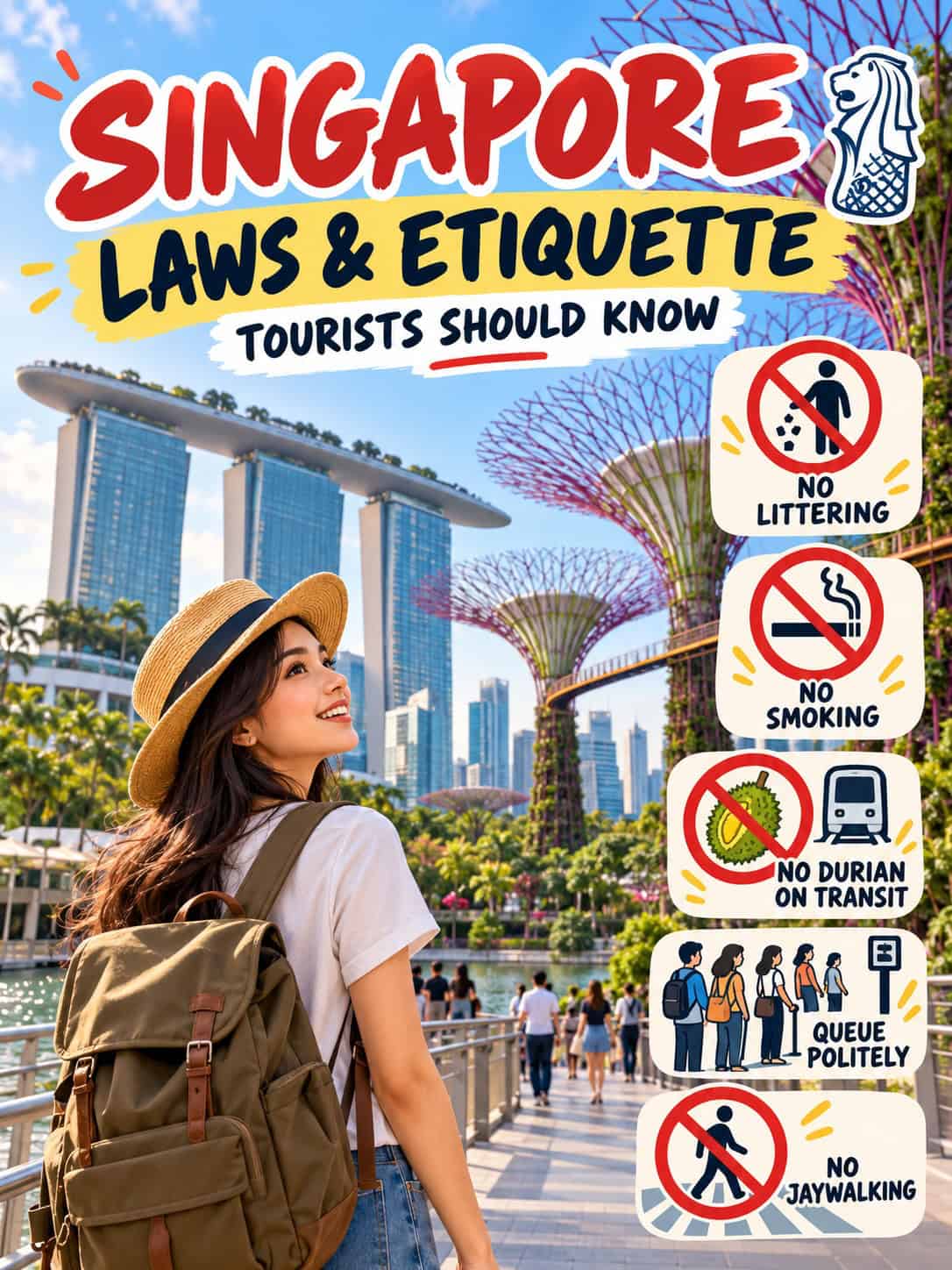
Singapore laws for tourists include restrictions on chewing gum imports, vaping, littering, public drinking, smoking and food consumption on transport. Under the Singapore chewing gum law, chewing itself is not a standalone crime, but importing ordinary gum is prohibited even for personal use. This practical 2026 guide separates actual laws and fines from social customs, including Singapore alcohol laws and Singapore tipping etiquette.
The Chewing Gum Myth, Corrected: Singapore Chewing Gum Law
The Singapore chewing gum law prohibits importing ordinary chewing gum, including small packs for personal consumption. Do not bring supermarket gum into Singapore. Chewing a lawfully possessed piece is not a separate crime; disposing of it as litter is. Bus interchanges are the exception: consuming or trying to consume chewing gum or bubble gum inside one carries a fine of up to S$500. Certain HSA-approved oral-dental and therapeutic gums have specific regulated exceptions. A pharmacy exception for an approved health product is not a general exemption for a tourist’s usual chewing gum. Travelers also cannot bring medicine in chewing gum form, such as oral dental gum, and nicotine gum bought outside Singapore is not allowed either. Nicotine replacement products approved in Singapore are sold at licensed pharmacies after a consultation with a pharmacist.
The restrictions were partly prompted by discarded gum interfering with public infrastructure, including MRT train doors. The practical distinction under the Singapore chewing gum law is between chewing gum, importing or selling it, and discarding it as litter. These are different legal questions and must not be confused.
Singapore Chewing Gum Law: What Is Actually Banned?
| Action | Rule for tourists |
|---|---|
| Chewing a lawfully possessed piece | Not itself a separate offence |
| Importing ordinary chewing gum | Prohibited even for small personal-use quantities |
| Selling ordinary chewing gum | Restricted under Singapore’s gum regulations |
| Approved medicinal or dental gum | Limited regulated exceptions |
| Dropping used chewing gum | Littering offence, with separate penalties |
The safest rule under the Singapore chewing gum law is simple: do not pack ordinary chewing gum. Do not confuse therapeutic dental products approved under health legislation with everyday supermarket gum.
Fines That Actually Catch Tourists Out
Littering usually attracts a S$300 composition amount for a first offence; the maximum court fine is S$2,000, rising to S$4,000 and S$10,000 for later convictions. Courts can also issue Corrective Work Orders of up to 12 hours. MRT and public buses: do not eat or drink, including water. The maximum fine is S$500; new bus rules took effect on 23 September 2026. Soiling a bus, bus interchange or terminal is treated more seriously, with a maximum penalty of S$5,000. Smoking: many public indoor areas, transport stops, play areas, hawker centres and entrances to smoke-free buildings are covered by prohibitions. The usual composition amount is S$200, with a court maximum of S$1,000. Follow site-specific signs and lawful smoking areas rather than assuming a universal yellow marking.
Besides the Singapore chewing gum law, cross roads at designated pedestrian crossings and obey traffic lights, especially near MRT stations. Do not reduce road-crossing law to one oversimplified 50-metre rule. Vaping is illegal in Singapore: buying, possessing or using e-vaporisers is prohibited, and since 1 May 2026 the maximum fine for these personal offences is S$10,000. Importing, distributing or selling vapes is a separate offence with potentially more severe penalties: importers face mandatory imprisonment of up to nine years and a fine of up to S$300,000, and suppliers up to six years and S$200,000. Do not carry vapes, refill liquids or prohibited components through customs.
Singapore Laws for Tourists: Fines and Penalties
| Conduct | Current rule or penalty |
|---|---|
| Littering, first offence | S$300 composition amount; up to S$2,000 on first court conviction |
| Repeat littering court convictions | Up to S$4,000 for second, S$10,000 for third and later |
| Corrective Work Order | Up to 12 hours of public cleaning work by court order |
| Food or drinks on MRT, including water | Prohibited; up to S$500 |
| Food or drinks on public buses | Prohibited; up to S$500 under Sep 2026 rules |
| Smoking in prohibited public area | S$200 composition; up to S$1,000 on conviction |
| Buying, possessing or using vape | Illegal; maximum S$10,000 from May 2026 |
| Public alcohol consumption during prohibited hours | First offence up to S$1,000; repeat up to S$2,000 and/or 3 months jail |
Like the Singapore chewing gum law, composition sums are not the same as maximum court fines. More serious import and supply offences carry their own penalties. Do not assume a first-time tourist will receive an informal warning.
Singapore Alcohol Laws: When and Where You Can Drink
| Place | Restriction |
|---|---|
| Ordinary public streets, parks and public spaces | No alcohol consumption from 10:30pm until 7am every day |
| Ordinary retail outlets selling takeaway alcohol | Licensed sales generally 7am–10:30pm |
| Licensed bars and restaurants | On-premises drinking allowed only during their permitted licence hours |
| Little India and Geylang Liquor Control Zones | Public drinking additionally prohibited 7am Saturday to 7am Monday |
| Little India/Geylang on public-holiday eves | Special public drinking restriction from 7pm until 7am the day after the holiday |
| Liquor retail in these zones, weekends and holidays | Usually ends by 7pm |
A bar’s valid licence does not make its surrounding pavement a legal drinking area after 10:30pm. Public drinking in restricted hours may incur a fine of up to S$1,000 for a first offence, or up to S$2,000 and/or three months’ imprisonment for repeat offences. Inside the Little India and Geylang Liquor Control Zones, these penalties are one and a half times higher.
Everyday Etiquette
For everyday etiquette, queue patiently, let other passengers alight first, avoid blocking escalators and offer priority seating to people who need it. Some behaviours are enforceable rather than merely rude: public transport rules also prohibit eating and drinking, loud audio and putting feet on seats in the relevant settings. The public-bus nuisance framework was strengthened from 23 September 2026.
At hawker centres, chope means informally reserving a table with a tissue packet, umbrella or another small item while ordering food. Respect this custom, and return trays and crockery afterward. Singapore tipping etiquette is simple: tips are optional. Many sit-down restaurants add a 10% service charge, but not all do. The prevailing GST is 9%, and GST also applies to the service charge when one is imposed. A pre-service, pre-tax S$100 restaurant bill with 10% service and 9% GST totals S$119.90. Taxi, Grab and hawker-stall tips are not expected. Staying connected helps with taxi apps and maps, so many visitors pick up a travel eSIM before landing.
Singapore Tipping Etiquette: Service Charge and GST
| Situation | Tip expected? | Note |
|---|---|---|
| Hawker centre | No | Return your tray after eating |
| Restaurant with 10% service charge | Additional tip not required | GST is charged on service fees too |
| Cafe without service charge | Optional | Not every venue adds service |
| Taxi or Grab | No | Rounding up is voluntary |
| Hotel staff | Optional | No compulsory fixed amount |
Sample Restaurant Bill
| Item | Amount |
|---|---|
| Food and drinks before charges | S$100.00 |
| 10% service charge | S$10.00 |
| Subtotal | S$110.00 |
| 9% GST on subtotal | S$9.90 |
| Final payable total | S$119.90 |
Unlike the Singapore chewing gum law, this example applies when the original amount excludes both charges. Some advertised menus already show GST-inclusive prices and not all outlets levy service charges. Tipping beyond the bill is discretionary.
Etiquette Versus Law on Public Transport
- Legal: no food or drink on public buses and trains, including water.
- Legal: do not create nuisances with loud audio or place feet on seats where prohibited.
- Courtesy: queue, let people alight first and offer priority seats.
- Hawker custom: respect chope-marked tables; return trays afterward.
Religious and Cultural Sites
Beyond the Singapore chewing gum law, temples, mosques and shrines are active places of worship. Follow each site’s dress code and visiting hours, remove shoes where required, stay out of restricted prayer spaces, and ask before photographing people or ceremonies. Some sites require more coverage than simply shoulders and knees. For example, Sultan Mosque has separate tourist-visit hours and does not admit sightseeing visitors on Fridays. Walk-in visits run Saturday to Thursday from 10am to noon and 2pm to 4pm, with entry through Gate 5. Men need sleeved tops and long pants, women need long-sleeved tops and ankle-length bottoms, and robes are lent at the counter on a first-come, first-served basis.
Bottom Line: Laws and Etiquette in Singapore
For the main Singapore rules for tourists, remember: do not import ordinary chewing gum, bring a vape, litter, smoke in prohibited areas or consume food or water on the MRT or public buses. The Singapore chewing gum law is the one most visitors get wrong. Public alcohol consumption is restricted at night, and Little India and Geylang have extra rules. Be considerate in queues, hawker centres and religious sites. See our guide on safety in Singapore for related drug-law information.
For more on the area, see our guide to Getting Around Singapore: MRT, Bus, and Grab Explained. You may also find useful our guide to Singapore Daily Budget: What It Really Costs to Visit.
FAQ: Singapore Chewing Gum Law and Tourist Rules
Will I actually get fined as a first-time tourist?
Yes, it can happen. First-time tourists can face enforcement and fines; there is no universal exemption for an honest mistake. Do not rely on being warned first for littering, consuming drinks on public transport, smoking in a prohibited area or possessing vapes.
Can I bring my own vape into Singapore?
No. Importing, purchasing, possessing and using e-vaporisers are prohibited. Since May 2026, personal purchase, possession or use can carry a maximum S$10,000 fine. Ordinary chewing gum also has no general personal-use import exception.
Is jaywalking really enforced?
Yes. Use marked crossings, obey pedestrian traffic lights and avoid stepping into the road where an appropriate crossing is provided. The applicable penalty depends on the specific offence and circumstances.
Is chewing gum illegal in Singapore?
Chewing itself is not a standalone crime, but importing ordinary chewing gum, even one pack for personal use, is prohibited under the Singapore chewing gum law. Certain approved medicinal and dental products have specific exceptions, but travelers cannot bring in their own medicated gum or nicotine gum bought abroad. Inside bus interchanges, consuming any gum can lead to a fine of up to S$500.
Can I bring a pack of gum into Singapore?
No. A small personal pack is not an exemption from the ban on ordinary chewing gum imports.
Can I drink plain water on the Singapore MRT?
No. Food and drink, including water, are prohibited on trains and in paid MRT areas. The maximum fine is S$500.
What are Singapore alcohol laws for tourists?
Public drinking is prohibited from 10:30pm to 7am daily; takeaway liquor retail is generally restricted to 7am–10:30pm. Licensed bars have different premises rules, and Little India and Geylang have stricter weekend and holiday restrictions.
Can you drink beer on a public street at midnight?
No. Public alcohol consumption after 10:30pm is prohibited. A first offence may carry a fine of up to S$1,000.
What is the standard littering fine in Singapore?
The usual first-offence composition amount is S$300; a first court conviction can result in a fine up to S$2,000.
Is tipping required in Singapore?
No. Many sit-down restaurants add 10% service charge, and GST is 9%. Additional gratuities are optional.
What does chope mean?
It is an informal practice of reserving a hawker centre seat with a small personal item while ordering food. Respect these reservations and return used trays afterward.