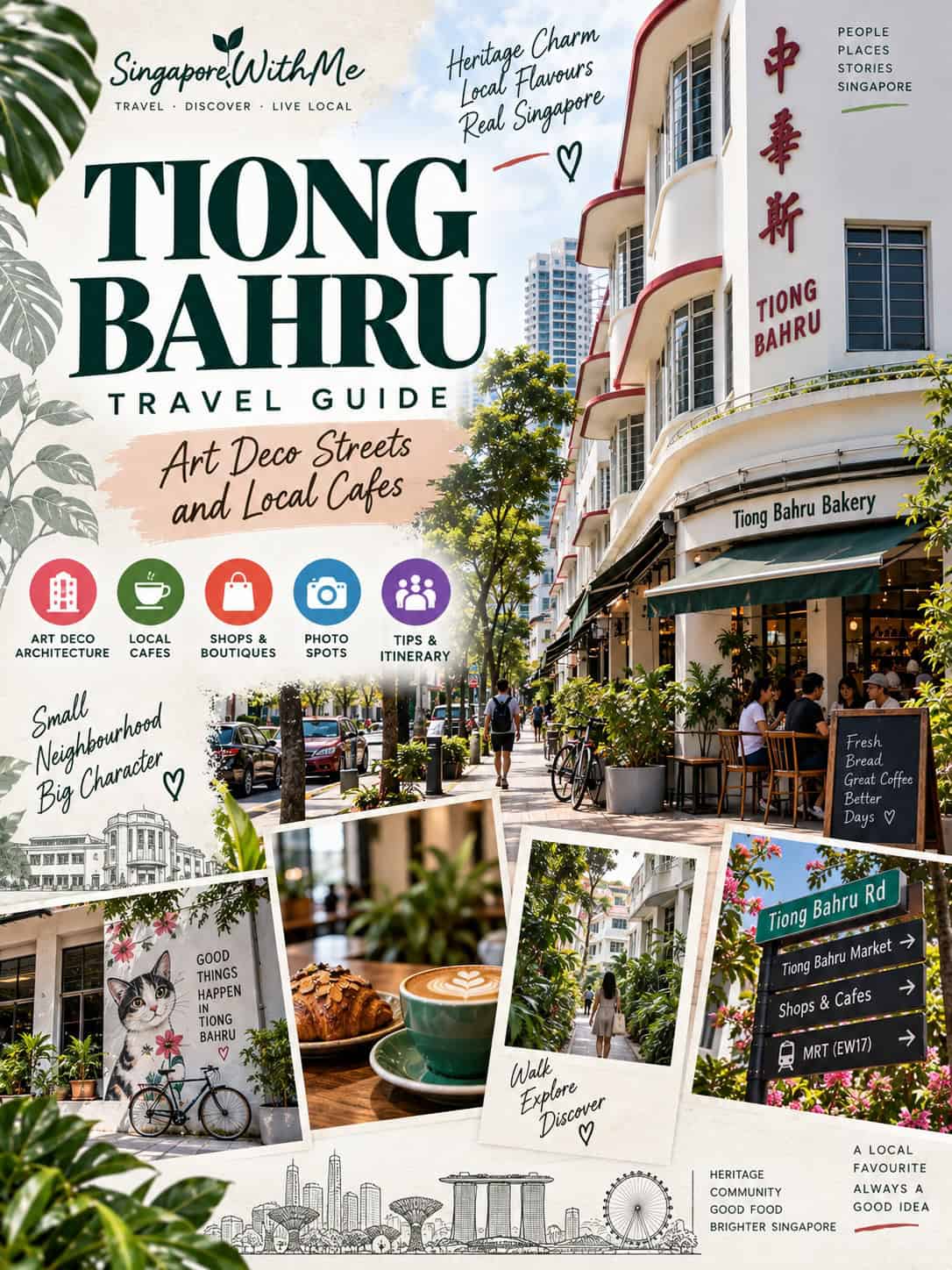
This Tiong Bahru travel guide takes you through one of Singapore’s earliest public housing estates, celebrated for its 1930s Art Deco and Streamline Moderne architecture, colourful cafes and lively hawker market. Start at Tiong Bahru Market, 30 Seng Poh Road, explore curved residential blocks and Block 78’s horseshoe façade, then continue to Eng Hoon Street and Yong Siak Street for bakeries and independent shops. The National Heritage Board’s 3.9 km heritage trail has 10 markers and can be walked in roughly an hour without lengthy stops. Allow 2–3 hours to include breakfast, photography and coffee. The public streets and heritage trail are free.
Tiong Bahru Travel Guide: Singapore’s Early Public Housing Estate
Tiong Bahru Art Deco architecture grew from an early public-housing programme by the Singapore Improvement Trust (SIT), the colonial-era predecessor of the Housing & Development Board. The pre-war housing estate took shape from 1936 through 1940, using the aerodynamic, rounded lines of Streamline Moderne. Architectural details include curved corners, horizontal bands, flat roofs, porthole-like windows and exterior staircases. These were originally practical homes, and they remain lived-in buildings today. The pre-war estate gained conservation status in 2003. Look at the façades from public paths rather than entering residential corridors or treating the buildings as an outdoor theme park. It remains an active residential neighbourhood: cafes and independent stores occupy some ground-floor units, while many blocks still contain occupied homes.
The Aeroplane Blocks and the Horseshoe Block
The so-called “aeroplane blocks” on Tiong Poh Road reflect the estate’s streamlined aesthetic. The standout is Block 78, Moh Guan Terrace / Guan Chuan Street, the curved horseshoe block built in 1939–1940. It contains a 1,500 sq m air-raid shelter designed for around 1,600 people, historically the only SIT public-housing block built with an air-raid shelter in its original design. The block spans both Moh Guan Terrace and Guan Chuan Street and is the largest block of flats in Tiong Bahru. The shelter is not a normal walk-in attraction: admire the horseshoe building and trail marker from public spaces; interior visits, if offered, require a separately organised heritage event. The regular heritage walk does not require entry to the shelter.
Tiong Bahru Art Deco: Free Heritage Trail Highlights
The National Heritage Board’s self-guided Tiong Bahru Heritage Trail contains 10 heritage markers, covers roughly 3.9 km and takes about one hour of walking without a café break. Start at the market at 30 Seng Poh Road; the route includes the pre-war blocks, the horseshoe-shaped Block 78, the former bird-singing corner and Qi Tian Gong, an old Monkey God temple on 44 Eng Hoon Street. Public street viewing and trail markers cost S$0. There are no tickets or reservations needed for the outdoor self-guided route, but private residences and the Block 78 shelter interior are not freely accessible. NHB numbers the ten markers as follows: the origin and development of Tiong Bahru, Bird Corner and the former Hu Lu Temple, the graves of Tan Tock Seng, Chua Seah Neo and Wuing Neo, the Outram precinct, the Monkey God Temple, the architecture of Tiong Bahru, Tiong Bahru Community Centre, Seng Poh Garden with its Dancing Girl sculpture, the Horse-Shoe Block and the design of the Tiong Bahru flats. The graves lie on a wooded hill along Outram Road, away from the cafe streets, so the highlights route below leaves them out. The trail booklet is a free download from the Roots.gov.sg trail page. If you would rather have a guide, look at guided walking tours in Singapore.
Which Architecture Details Are Worth Photographing?
- Rounded façades and balconies: the aerodynamic Streamline Moderne style of the 1930s blocks.
- Horizontal bands: simple lines designed to make the buildings look elongated.
- Spiral staircases: distinctive exterior forms visible from public areas.
- Porthole-style windows: a nautical reference in the original housing design.
- Five-foot ways: sheltered ground-floor pedestrian walkways.
- Block 78 horseshoe: curved streetscape at Moh Guan Terrace and Guan Chuan Street.
Tiong Bahru Market and the Streets Around It
Tiong Bahru Market is at 30 Seng Poh Road, Singapore 168898. The wet market is on Level 1 and the hawker centre is on Level 2; head upstairs for breakfast or lunch. The hawker center has more than 80 cooked-food stalls, and each sets its own hours and closing days. Like other NEA hawker centers, the market closes for a cleaning day each quarter, and NEA lists the dates on its hawker center closure schedule. The car park is on Level 3. Try Jian Bo Shui Kueh (#02-05) for steamed rice cakes topped with preserved radish, Hong Heng Fried Sotong Prawn Mee (#02-01) for fried prawn-and-squid noodles, or Tow Kwar Pop (#02-06) for rojak and tofu puffs. Hong Heng’s published hours are Tuesday–Saturday 10:30am–2:30pm, closed Sunday and Monday, so it is a lunch stop rather than a reliable evening choice. Eng Hoon Street and Yong Siak Street are nearby for cafes, bakeries and small shops. For a full rundown of where to eat on those two streets, see our guide to the best cafes and bakeries in Tiong Bahru.
Tiong Bahru Market: Stalls, Hours and Breakfast Tips
| Stop | Where | Best for | Published opening hours |
|---|---|---|---|
| Wet market | 30 Seng Poh Rd, Level 1 | Produce, seafood and local market atmosphere | Individual stall hours; early morning best |
| Hawker centre | 30 Seng Poh Rd, Level 2 | Breakfast and lunch | Individual stall hours; no universal closing time |
| Jian Bo Shui Kueh | #02-05 | Chwee kueh / steamed rice cakes | Daily about 7am–8pm |
| Hong Heng Fried Sotong Prawn Mee | #02-01 | Fried Hokkien-style prawn and squid noodles | Tue–Sat 10:30am–2:30pm; closed Sun/Mon |
| Tow Kwar Pop | #02-06 | Rojak and tofu puffs | Closed Monday; other hours vary by weekday |
The hawker centre is upstairs, not inside the wet-market hall. Individual stalls may sell out earlier than their advertised closing times. For an early breakfast, aim for around 8–10am; for Hong Heng’s noodles, plan a weekday or Saturday lunch.
Getting There and Practical Tips
Tiong Bahru how to get there: take the East–West Line to Tiong Bahru MRT (EW17) and follow Exit A towards the historic estate. The walk to Tiong Bahru Market takes roughly 7–10 minutes; allow longer for the more distant residential blocks or a leisurely café stop. Exit B leads to Tiong Bahru Plaza rather than the market-side heritage streets. Havelock MRT (TE16) is another option, approximately an 8–12-minute walk from the market depending on the exit and route. The best time for hawker breakfast and a quiet Tiong Bahru travel guide walk is generally 8–11am on a weekday. Take photos from public pavements and avoid entering residential stairwells or blocking doorways.
Tiong Bahru How to Get There: MRT and Walking Plan
| Starting point | Destination | Approximate walk |
|---|---|---|
| Tiong Bahru MRT (EW17), Exit A | Tiong Bahru Market, 30 Seng Poh Road | 7–10 minutes |
| Havelock MRT (TE16) | Tiong Bahru Market | 8–12 minutes |
| Tiong Bahru Market | Eng Hoon Street bakeries | About 3–6 minutes |
| Tiong Bahru Market | Block 78 Moh Guan Terrace | About 5–8 minutes |
Tiong Bahru Cafes and Bakery: Addresses, Hours and Prices
| Place | Address | Published hours | Practical choice |
|---|---|---|---|
| Tiong Bahru Bakery | 56 Eng Hoon St, #01-70 | Mon–Fri 7:30am–8pm; weekends 8am–8pm | Croissant S$4.80; kouign-amann S$6.20, before GST |
| Drips Bakery Studio | 71 Seng Poh Rd, #01-37 | Daily 8am–6pm | Tarts and pastries near the market |
| Merci Marcel | 56 Eng Hoon St, #01-68 | Sun/Mon 8am–9:30pm; Tue–Thu 8am–10pm; Fri/Sat 8am–11pm | Sit-down French café; tables bookable |
| Qi Tian Gong | 44 Eng Hoon St | Daily around 8am–4pm | Historic Monkey God temple, free general visiting |
The bakery’s listed croissant plus kouign-amann cost S$11.00 before GST, or approximately S$11.99 with 9% GST, excluding drinks. The market offers less expensive local-food alternatives, but exact hawker prices and daily availability vary.
Two-to-Three-Hour Tiong Bahru Walking Itinerary
- 8:30am: Arrive at Tiong Bahru MRT Exit A and walk to the market.
- 8:40–9:15am: Explore Level 1 wet market, then have breakfast upstairs on Level 2.
- 9:15–9:45am: Follow the heritage trail past pre-war façades and the former bird-singing corner.
- 9:45–10:15am: Walk around Block 78 and the horseshoe architecture; do not attempt to enter the closed shelter.
- 10:15–10:45am: See Qi Tian Gong on Eng Hoon Street and explore the independent shops.
- 10:45–11:15am: Finish with Tiong Bahru Bakery or another café on Eng Hoon or Yong Siak Street.
This is a convenient highlights route rather than the entire 3.9 km NHB route. For all 10 heritage markers at a leisurely pace plus meals, allow more time. The outdoor walk is free, and ordinary MRT fares and food purchases are separate.
Midday Heat and Afternoon Rain in Tiong Bahru
Storms usually come in the afternoon or early evening and pass quickly, and from March to May afternoons often pass 32°C, so the morning start in this itinerary works all year. In a downpour, the covered hawker center and the sheltered five-foot ways of the pre-war blocks keep you dry, and Tiong Bahru Plaza connects directly to Exit B of Tiong Bahru MRT if you want a longer indoor break.
Bottom Line: Tiong Bahru Travel Guide
Tiong Bahru travel guide essentials: start at Tiong Bahru Market for hawker breakfast, walk the free 10-marker heritage route to see the curved pre-war flats and Block 78, then stop at Tiong Bahru Bakery or other Tiong Bahru cafes along Eng Hoon and Yong Siak Streets. Allow 2–3 hours, bring water and remember the air-raid shelter is not open as a normal walk-in museum. Our boutique hotels near Tiong Bahru guide covers where to stay if you want to base yourself here.
For more nearby, see our guide to Holland Village: Nightlife and International Dining.
FAQ: Tiong Bahru Travel Guide
What is Tiong Bahru famous for?
Tiong Bahru is known for its 1930s Art Deco and Streamline Moderne apartment blocks, heritage trail, traditional food market and neighbourhood cafes.
Where is Tiong Bahru Market?
At 30 Seng Poh Road, Singapore 168898. The wet market is on the ground floor and the hawker centre is on Level 2.
Which MRT exit is best for Tiong Bahru Market?
Use Tiong Bahru MRT (EW17), Exit A. The walk takes roughly 7–10 minutes.
Is the Tiong Bahru heritage trail free?
Yes. The self-guided outdoor NHB route has 10 markers, covers approximately 3.9 km and does not require an admission ticket.
Can I visit the air-raid shelter under Block 78?
It is not normally open for walk-in entry. The shelter measures about 1,500 square metres and was designed for 1,600 people; visits inside are limited to special organised access.
Where are the best Tiong Bahru cafes?
Eng Hoon Street and Yong Siak Street are the main café areas. Tiong Bahru Bakery is at 56 Eng Hoon Street #01-70, and Merci Marcel is next door at #01-68.
What are Tiong Bahru Bakery opening hours?
The Eng Hoon Street branch lists Monday–Friday 7:30am–8pm and Saturday–Sunday 8am–8pm.
How much time do I need in Tiong Bahru?
Allow 2–3 hours for breakfast, architecture and a café. The 3.9 km heritage trail alone takes about an hour of walking without extended stops.
Is Tiong Bahru still residential?
Yes. The conserved pre-war blocks contain occupied homes. Treat residential corridors and entrances as private spaces.
Can I combine Tiong Bahru with another neighbourhood?
Yes. Nearby Chinatown and Holland Village are possible follow-on visits by MRT.