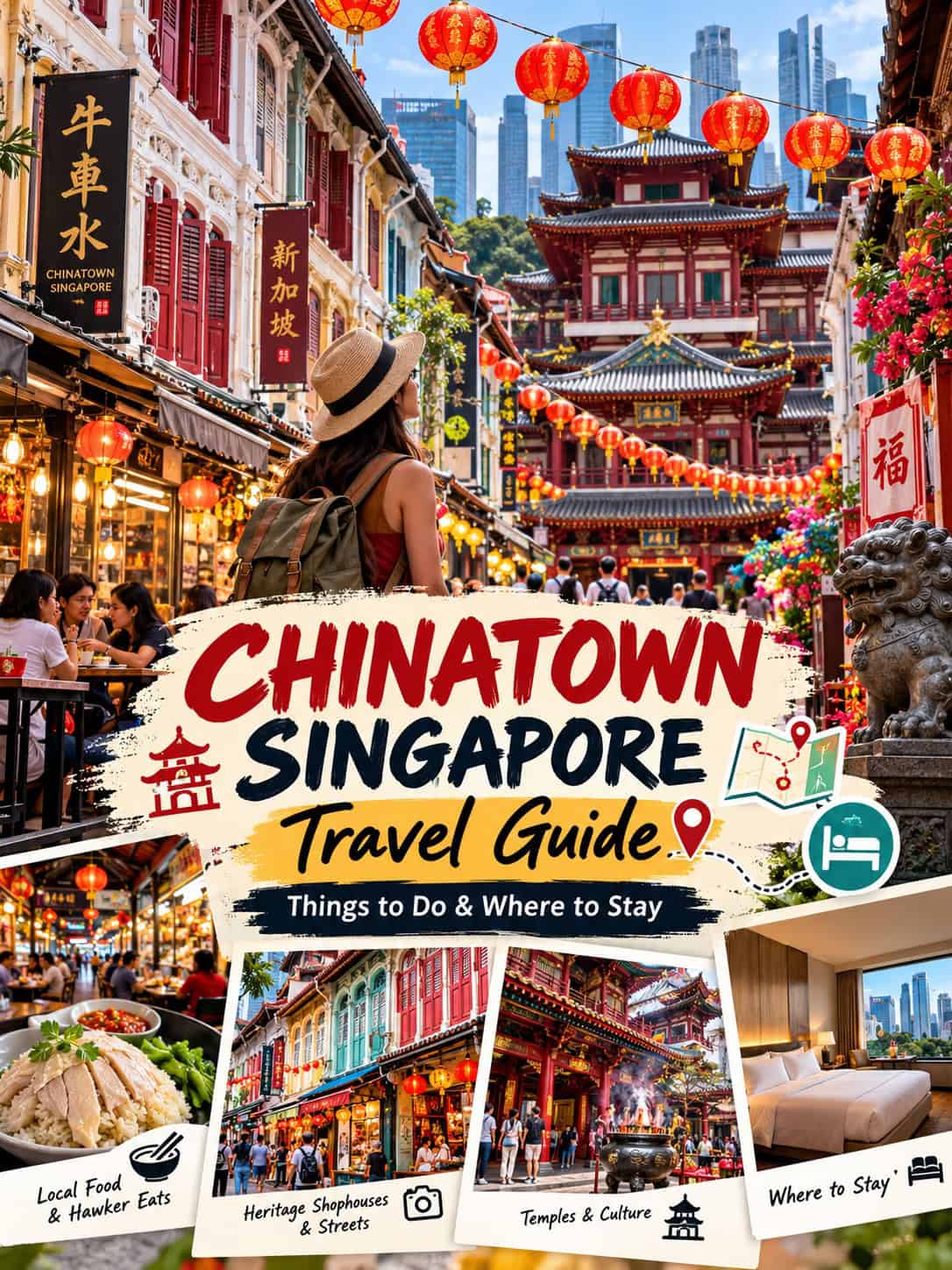
The best things to do in Chinatown Singapore include three historic temples, the free street market, two major hawker centres, and the restored shophouses of Ann Siang Hill. This practical Chinatown travel guide compares opening hours, entry costs, MRT stops, local food and where to stay in Chinatown. Most highlights fit into a four-to-six-hour walking route, with extra time for the paid Chinatown Heritage Centre.
Things to Do in Chinatown Singapore: Getting There and Around
Chinatown MRT (NE4/DT19) is the easiest starting point for Pagoda Street and Chinatown Heritage Centre at Exit A. Maxwell MRT (TE18) is convenient for Buddha Tooth Relic Temple, Sri Mariamman Temple and Maxwell Food Centre. Telok Ayer MRT (DT18) serves Thian Hock Keng Temple. The walk between the older market core and Telok Ayer includes outdoor streets; do not assume a continuous sheltered route between MRT stations.
The central market, temples and food stalls are walkable, but allow extra time for the Telok Ayer and Ann Siang Hill sections. Plan on 4–6 hours for the main heritage circuit with food stops, or 2–3 hours if you skip the more distant stops and paid museum.
Chinatown Singapore Attractions: Quick Prices and Opening Hours
| Place | Address | Published hours | Admission |
|---|---|---|---|
| Buddha Tooth Relic Temple | 288 South Bridge Road | Daily 7am–5pm | Free |
| Sri Mariamman Temple | 244 South Bridge Road | Daily 6am–noon; 6pm–9pm | Free |
| Thian Hock Keng Temple | 158 Telok Ayer Street | Daily 7:30am–5pm | Free |
| Chinatown Complex Food Centre | 335 Smith Street | Daily 7am–10pm; stall hours differ | Free entry; meals extra |
| Maxwell Food Centre | 1 Kadayanallur Street | Centre listed 8am–2am; stalls differ | Free entry; meals extra |
| Chinatown Heritage Centre | 48 Pagoda Street | Daily 10am–8pm; last entry 7:15pm | S$25 adult non-resident; S$20 child 3–12 or senior 60+ |
Check the schedule of the specific stall or ticketed museum experience. Temple worship and special events can affect visitor access.
Buddha Tooth Relic Temple and Museum
Buddha Tooth Relic Temple and Museum at 288 South Bridge Road offers free admission and opens daily from 7am to 5pm. The Buddhist museum also closes at 5pm. Highlights include the ground-floor Hundred Dragons Hall, the fourth-floor Sacred Light Hall with its revered tooth relic, and the rooftop garden with a prayer wheel. Allow approximately 45–90 minutes, depending on which galleries are open and your interest in Buddhist art.
Dress modestly: avoid shorts, miniskirts, bare shoulders, low-cut tops, exposed backs and spaghetti straps. Entry may be refused for inappropriate clothing, so do not rely on free sarongs being available. Follow posted photography rules, particularly near worshippers and the relic hall.
Sri Mariamman Temple
Sri Mariamman Temple, Singapore’s oldest Hindu temple, stands at 244 South Bridge Road. It was founded in 1827 by Naraina Pillai, a government clerk who arrived with Stamford Raffles, and gazetted a National Monument in 1973. The five-tiered gopuram, decorated with Hindu deities, is a Chinatown landmark. Admission is free. Its published visiting hours are 6am–noon and 6pm–9pm daily. Remove footwear before entering and wear clothing covering shoulders and knees. A cover-up may be available at the entrance, but carrying appropriate clothing is more reliable. Schedule the temple before noon or after 6pm, not during the afternoon closure. About a week before Deepavali, it hosts the Theemithi firewalking festival — worth timing a visit around if it lines up with a trip.
The Street Market: Pagoda, Trengganu and Sago Street
The pedestrianized core between Pagoda, Trengganu and Sago Street is candidly touristy — souvenir stalls selling zodiac keychains, fans, printed T-shirts and paper lanterns run mid-morning to around 10pm daily, free to browse. It’s worth knowing that this isn’t the place for authentic bak kwa (Chinese barbecued pork jerky) despite the volume of it on sale; the better versions are a short walk away on New Bridge Road. The market is at its best in the evening once the lanterns are lit — worth timing a visit for dusk rather than midday if atmosphere matters more than avoiding crowds.
Chinatown Heritage Centre: Museum Tickets and Discounts
The Chinatown Heritage Centre at 48 Pagoda Street is a paid indoor museum of migrant life inside restored shophouses. It opens daily 10am–8pm, with final admission at 7:15pm. Standard non-resident admission is S$25 for adults aged 13–59 and S$20 for children aged 3–12 or seniors aged 60+. Standard resident admission is S$15 for adults or S$12 for eligible children and seniors. Children younger than three enter free.
Foreign visitors can use the published last-hour offer: S$15 admission from 7pm to 8pm, subject to availability, leaving less than an hour before closing. The museum advertises a birthday-month free-entry benefit with valid identification. Check for scheduled maintenance closures before you go. Allow roughly 45–75 minutes for the galleries, and book ahead for preferred slots if the visit is essential.
Chinatown Complex Food Centre: Things to Do in Chinatown Singapore for Food Lovers
Chinatown Complex Food Centre is at 335 Smith Street, with around 260 cooked-food stalls on the upper floor and market facilities below. The published centre hours are 7am–10pm daily, but individual stalls may open later, close earlier or take weekly rest days. Hawker Chan became famous for its former Michelin star, which it lost in 2021; do not advertise a current Michelin star or assume its former recognition automatically applies today. Other choices include claypot rice, noodles, satay and local desserts, and Er Gu Tang Shui has been serving Cantonese desserts since 1955. For a specific dish, check that stall’s current availability rather than assuming every vendor is open throughout centre hours.
Stall hours can vary considerably even while the centre is open from 7am to 10pm. Plan lunch during the day and consider Maxwell Food Centre, at 1 Kadayanallur Street, as another nearby hawker option if a particular stall is closed.
Chinatown Food Centre vs Maxwell: Which Should You Choose?
| Food centre | Address | Main advantage | Watch for |
|---|---|---|---|
| Chinatown Complex | 335 Smith Street | Wide selection of about 260 hawker stalls; easy after the street market | Individual stalls have different rest days and hours |
| Maxwell Food Centre | 1 Kadayanallur Street | Close to Maxwell MRT and South Bridge Road temples; famous chicken rice options | Popular stalls can have substantial queues |
Neither food centre requires an admission ticket. Meal prices depend on the stall and order. Check menus at the counter rather than relying on a fixed price per dish.
Thian Hock Keng Temple and the Ann Siang Hill Shophouse District
Thian Hock Keng Temple is at 158 Telok Ayer Street, near Telok Ayer MRT (DT18). This free-entry temple dedicated to Mazu is open daily from 7:30am to 5pm. Look for southern Chinese roof decorations, dragons and porcelain details. It is easier to visit before exploring bars around Ann Siang Hill, since temple visiting ends in the late afternoon.
From there, Ann Siang Hill and Club Street form a different Chinatown entirely: restored shophouses now holding wine bars, boutique cafés and a scattering of restaurants (L’Antica Pizzeria Da Michele, Bochinche, Le Bon Funk), quiet by day and busier after dark. Ann Siang Hill Park, at the top of the rise, is the highest point in Chinatown and a genuine skyline lookout most visitors walk straight past.
Where to Stay in Chinatown: Boutique and Business Hotels
Duxton Reserve and Maxwell Reserve — both part of Marriott’s Autograph Collection in restored heritage shophouses on the Tanjong Pagar/Duxton edge of Chinatown — are the district’s standout boutique picks (both operated under the Six Senses name until Six Senses exited Singapore around 2020-2021, so ignore any older write-up still calling them that). Ann Siang House, in a converted shophouse directly on Ann Siang Hill, is the closest boutique option to the Club Street bar scene. For a larger, more conventional hotel at the edge of the district, Amara Singapore sits right at Tanjong Pagar.
Where to Stay in Chinatown: Choose Your MRT Area
| Area | Best for | Nearby station | Trade-off |
|---|---|---|---|
| Pagoda Street / Chinatown core | Street market, temple walks and hawker food | Chinatown NE4/DT19 | Busy pedestrian streets and evening activity |
| Maxwell / Kreta Ayer | Heritage sights and food-centre access | Maxwell TE18 | Smaller heritage properties may have fewer facilities |
| Telok Ayer / Ann Siang Hill | Boutique hotels, restaurants and nightlife | Telok Ayer DT18 | Some streets have hills and evening noise |
| Tanjong Pagar / Duxton | Business hotels and restaurant choice | Tanjong Pagar EW15 | Walk or ride to Pagoda Street attractions |
Compare hotel rates for your actual travel dates; room sizes, access and breakfast arrangements vary widely even within the same area. If nightlife is important, favour Telok Ayer or Duxton; for temple visits and public transport, stay near Chinatown or Maxwell MRT.
Things to Do in Chinatown Singapore: Half-Day Walking Route
| Time | Stop | Cost |
|---|---|---|
| 9:00–9:45am | Buddha Tooth Relic Temple; visit after 7am opening | Free |
| 9:45–10:15am | Sri Mariamman Temple, before noon closure | Free |
| 10:15–11:00am | Pagoda Street and Trengganu Street market | Free browsing |
| 11:00am–noon | Chinatown Complex or Maxwell Food Centre for lunch | Meal extra |
| Noon–1:00pm | Chinatown Heritage Centre (optional) | S$25 standard non-resident adult |
| 1:00–2:00pm | Walk to Thian Hock Keng and Ann Siang Hill | Free temple entry |
Without the museum, the route has no required attraction-admission expense; food and personal purchases are additional. A museum visit makes the standard adult admission budget S$25. The schedule is illustrative and includes transfer time rather than guaranteed appointment slots. A fuller route with Thian Hock Keng, Ann Siang Hill and a museum stop takes about 4–6 hours, and an evening back in the market once the lanterns are lit adds atmosphere.
Chinatown Budget: Free Attractions vs Paid Museum
Three important religious attractions — Buddha Tooth Relic Temple, Sri Mariamman Temple and Thian Hock Keng Temple — are free to enter. Chinatown street markets and heritage streets can also be explored without admission fees. The main paid indoor stop is Chinatown Heritage Centre at S$25 for a standard adult non-resident ticket. For two adults, the museum adds S$50; a family with two eligible children aged 3–12 pays S$90 in standard museum admission. Choose a no-ticket heritage walk if you prefer to spend your budget on local food instead.
Bottom Line: Things to Do in Chinatown Singapore in Short
Chinatown’s South Bridge Road temples, the Smith Street hawker centre, and the quieter Ann Siang Hill shophouse district cover faith, food and history, though the Telok Ayer stops sit further from the tourist core. For deeper coverage of two specific stops, see our guides to the Buddha Tooth Relic Temple and the Chinatown Street Market and Pagoda Street. For where to eat specifically, this site’s broader guide to Singapore’s best food courts and hawker centres covers more ground beyond Chinatown Complex, and a guided Chinatown food or heritage tour is an easy way to cover several stops with a local guide.
Things to Do in Chinatown Singapore: Frequently Asked Questions
How much time should I set aside for Chinatown?
Allow 2–3 hours for Chinatown MRT, Pagoda Street, Buddha Tooth Relic Temple, Sri Mariamman Temple and a quick hawker meal, provided the Hindu temple is within its visiting window. A fuller route with Thian Hock Keng, Ann Siang Hill and a museum stop takes about 4–6 hours.
Is the Chinatown street market worth it, or is it just for tourists?
It’s genuinely touristy — most of what’s sold on Pagoda and Trengganu Street is standard souvenir stock. It’s still worth a walk-through, especially in the evening when it’s lit up, just without expecting an authentic local market experience.
What’s the best time of year to visit Chinatown?
The weeks leading up to Chinese New Year bring extensive light-up decorations and bazaars, and are the most festive time to visit — also the most crowded, so it’s a trade-off rather than a clear best answer.
What are the best free things to do in Chinatown Singapore?
Visit Buddha Tooth Relic Temple, Sri Mariamman Temple and Thian Hock Keng Temple; explore Pagoda Street and Ann Siang Hill. These locations do not charge standard admission.
What are Buddha Tooth Relic Temple opening hours?
Daily 7am–5pm. The museum also closes at 5pm, so do not plan an early 4:30am or late-night visit.
When is Sri Mariamman Temple open?
The published visiting schedule is 6am–noon and 6pm–9pm daily. Admission is free, footwear must be removed and modest dress is required.
Is Chinatown Heritage Centre free?
No. Standard adult non-resident admission is S$25. The published foreign-visitor last-hour rate is S$15 from 7pm to 8pm, subject to availability.
Which Chinatown food centre is better for lunch?
Chinatown Complex has approximately 260 hawker stalls at 335 Smith Street. Maxwell Food Centre is convenient for the South Bridge Road temples and Maxwell MRT. Stall hours vary at both.
Where to stay in Chinatown for nightlife?
Telok Ayer, Ann Siang Hill and Duxton suit visitors prioritising restaurants, bars and boutique accommodation. Chinatown MRT or Maxwell is a better base for temple sightseeing.
How much does a Chinatown Singapore sightseeing day cost?
A walking route through the temples, streets and hawker centres has no compulsory attraction admission. Chinatown Heritage Centre adds S$25 for a standard non-resident adult ticket; meals and shopping are extra.