West of the bay’s glass towers, the Civic District is Singapore’s colonial-era core — a cluster of 19th and early-20th-century buildings, a historic open field, and a handful of museums housed in former government buildings, all within a comfortable walking loop. This Civic District walking guide is a slower, architecture-and-history half-day compared to Marina Bay’s headline attractions, and it pairs naturally with a Merlion Park visit since the two sit right next to each other.
National Gallery Singapore
The centerpiece of the district, National Gallery Singapore occupies two connected colonial landmarks — the former Supreme Court (1939) and the former City Hall (1929) — joined by a covered courtyard. Inside is the world’s largest public collection of modern Southeast Asian art, spanning the 19th century to today. Admission is free for Singapore citizens and permanent residents; other visitors pay S$20 for general admission or S$30 for an All Access ticket covering special exhibitions. The gallery is open daily, 10am–7pm, with last admission at 6:30pm. Children 6 and under enter free, children 7 to 12, seniors 60 and above, and overseas students and teachers get S$5 off, and guided highlights tours are free with an admission ticket, subject to schedule and availability. Budget at least 2–3 hours if you want a proper look rather than a quick pass-through — it’s a genuinely large building.
National Gallery Singapore: Bags, Strollers and Practical Rules
- Bags and umbrellas: bulky items, large bags and umbrellas go in the lockers on Basement 1 (City Hall Wing), and bags may be inspected at the door.
- Food and drink: none is allowed in the galleries, bottled water included. Eat and drink at the restaurants and bars inside the Gallery.
- Photos: non-commercial photography without flash is fine. Flash, videography, selfie sticks and tripods are not allowed, and some special exhibition galleries on Levels 3 and 4 of the City Hall Wing restrict photography.
- Strollers and wheelchairs: strollers are allowed in the galleries and can be parked on Level 1 at the entrance of the Keppel Centre for Art Education. Free wheelchair loans are available at the Visitor Services Counters at the Coleman Street Entrance, the Padang Atrium Entrance and the Basement 1 Concourse.
- Baby care: baby changing rooms are in the City Hall Wing on every level except Level 6, plus one at the Parliament Place Entrance.
- What to wear: there is no dress code, but the exhibition spaces are climate-controlled, so bring something warm.
- Free entry: besides citizens and permanent residents, children 6 and under, students and teachers based in Singapore, and persons with disabilities with one caregiver enter free.
The Padang
Directly in front of the old City Hall building sits the Padang, an open field that’s been used for cricket since the 1830s and still hosts the Singapore Cricket Club at its southern end. It’s freely accessible to walk across at any time, and it’s where National Day Parade rehearsals and major public events still take place today — genuinely still in active civic use rather than a preserved-but-empty historic space.
St Andrew’s Cathedral
A short walk from the Padang, this Anglican cathedral was completed in 1862 in neo-Gothic style and remains free to enter daily, with visiting hours from 7am to 8pm (closed on selected public holidays); guided tours are booked through the cathedral’s Welcome Centre. One detail worth knowing before you go: the interior’s smooth white plaster finish was historically achieved using “Madras chunam,” a traditional technique mixing lime plaster with egg whites, sugar, and coconut husks — a small but genuinely interesting piece of colonial-era building craft rather than just another white church interior.
The Arts House (Old Parliament House)
Built in 1827, this is one of Singapore’s oldest surviving government buildings, and it now functions as a multi-arts venue with occasional free exhibitions and performances rather than a government seat. Even without an event on, the exterior alone — one of the district’s most distinctive colonial facades — is worth the short detour from the riverfront.
Victoria Theatre and Concert Hall
Fully restored after a major renovation, this riverfront landmark’s clock tower is one of the most recognizable colonial silhouettes along the river. The Concert Hall inside is regarded as one of Singapore’s best acoustic performance venues, so if a show happens to be scheduled during your visit, it’s worth checking — otherwise the building itself is a solid photo stop on the walk between the Padang and the river.
Asian Civilisations Museum
On the riverfront at Empress Place, this museum has occupied the Neoclassical Empress Place building since 2003 (construction ran from June 1864 to December 1867) and focuses on the history and material culture connecting Singapore to the wider Asian trade and migration networks. Its strongest single collection comes from a shipwreck salvage — the Tang shipwreck finds, one of the most significant troves of 9th-century Chinese ceramics ever recovered from a single site. Adult admission runs around S$20 for non-residents, generally free for citizens and permanent residents, broadly in line with National Gallery’s pricing tier since both fall under Singapore’s National Heritage Board. The museum is open 10am to 7pm daily and until 9pm on Fridays, with last admission 30 minutes before closing. Special exhibitions are ticketed separately: the current one costs foreign adults S$25, with S$20 for seniors 60 and above and students, and children 6 and under enter free.
Guided walking tours cover much of this same ground if you’d rather have the history explained on the spot than read it off a plaque — several local operators run 2-to-3-hour Civic District walking tours through National Gallery Singapore, the Padang, and the riverfront landmarks, which can be worth the cost if you’re short on research time or traveling with kids who do better with a live storyteller than a self-guided route.
Raffles’ Landing Site
At the north bank of the Singapore River near Cavenagh Bridge, a statue marks the approximate spot where Stamford Raffles is said to have landed on January 29, 1819. The white polymarble statue standing here today is a replica, unveiled in 1972 — the original bronze statue, unveiled in 1887, was reinstalled in July 1946 at Victoria Memorial Hall, the Victoria Theatre and Concert Hall building, where it still stands.
A Rough Civic District Walking Route
- Start at City Hall MRT. Exit B comes out beside the entrance to St Andrew’s Cathedral and Exit A leads toward the Padang; Exit E leads toward Victoria Theatre and the Asian Civilisations Museum. Exit B is the quickest way to National Gallery Singapore, about a 7-minute walk via the Art Connector.
- Walk the Padang and into National Gallery Singapore — budget the bulk of your morning here if art and architecture are the priority.
- Head toward the river via the Arts House and Victoria Theatre, ending at Asian Civilisations Museum and Raffles’ Landing Site.
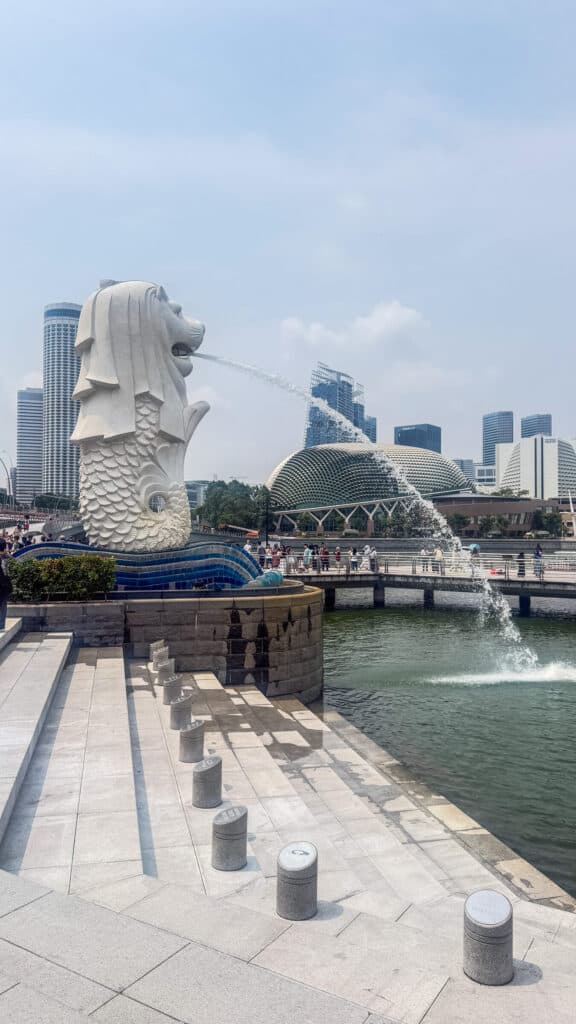
- Finish at Merlion Park, a five-minute walk further along the riverfront, to close the loop with the district’s most photographed view.
Self-Guided Route Options and Distances
If you would rather follow a ready-made trail than the rough route above, the National Heritage Board publishes three short self-guided routes through 22 heritage points, and NParks runs a separate free monument walk along the river.
| Route | Distance | Time on foot |
|---|---|---|
| Journey to Nationhood (National Heritage Board) | 550 m | 0.5 hour |
| Seeking Fortunes, Forging New Lives (National Heritage Board) | 1 km | 1 hour |
| Functions of the Civic District (National Heritage Board) | 2.2 km | 1.5 hours |
| Monument trail via Esplanade Park, Empress Place and War Memorial Park (NParks) | 1.5 km | 45 minutes |
The Heritage Board trail has a booklet and map to follow, while the NParks walk is rated easy and is free for a self-guided visit.
Getting There and Best Time to Visit
City Hall MRT sits directly in the middle of the district, with Raffles Place and Esplanade stations both walkable from the river end. The whole loop is genuinely comfortable to walk, but the 11am–3pm stretch makes outdoor walking between buildings unpleasant in Singapore’s heat — early morning or late afternoon into evening works far better, and it also means better light for photos of the colonial facades.
What the Civic District Costs
| Stop | Cost for a non-resident adult | Hours |
|---|---|---|
| National Gallery Singapore | S$20 general admission, S$30 All Access; S$5 off for children 7 to 12, seniors 60 and above, and overseas students and teachers | 10am to 7pm daily, last admission 6:30pm |
| Asian Civilisations Museum | See venue for the permanent galleries; S$25 for the current special exhibition (S$20 concession) | 10am to 7pm, until 9pm on Fridays |
| St Andrew’s Cathedral | Free | 7am to 8pm daily, closed on selected public holidays |
| The Padang | Free | Open field |
Citizens and permanent residents get free general admission at both museums, and children 6 and under are free at the Gallery and for ACM special exhibitions.
If It Rains
Both big stops are indoors. Swap the outdoor stretches for an extra hour at National Gallery Singapore, reached from City Hall MRT Exit B by the Art Connector, and drop your umbrella and large bag in the Basement 1 lockers. The Asian Civilisations Museum is open until 9pm on Fridays, which makes it the natural wet-evening stop, while the Padang, Raffles’ Landing Site and the Victoria Theatre facade are quick stops between showers.
Buses and Other Stations
Besides City Hall, Raffles Place Exit B is about a 10-minute walk to National Gallery Singapore through the business district, and Clarke Quay Exit E is about 10 minutes along the river. By bus, services 195 and 961 stop along Parliament Place by the Padang Atrium Entrance, and services 75, 100, 107, 130, 131 and 167 stop at Victoria Concert Hall, about a 5-minute walk from that entrance. Services 63, 51, 80, 32 and 851 stop opposite Peninsula Plaza, a 5-minute walk from the Coleman Street Entrance.
For how the Civic District fits into a wider Marina Bay itinerary, see this site’s Marina Bay travel guide. If you’re finishing your walk at the waterfront, this site’s Merlion Park guide covers the best photo timing for the statue right next door.
Frequently Asked Questions
How long does the Civic District walk take?
Walking between all the landmarks without going inside any museum takes about 2 hours. Add National Gallery Singapore properly and it becomes a genuine half-day, especially with a stop at Merlion Park to finish.
Is the Padang free to visit?
Yes — it’s an open public field with no admission fee or gate, accessible any time.
Is National Gallery Singapore free?
Free for Singapore citizens and permanent residents. Other visitors pay S$20 for general admission or S$30 for an All Access ticket covering special exhibitions.
What’s the closest MRT station to the Civic District?
City Hall MRT sits in the middle of the district, with direct access to the Padang from Exit A. For National Gallery, use Exit B, about a 7-minute walk via the Art Connector.
Bottom Line
The Civic District is the slower, history-focused counterpart to Marina Bay’s glass-and-neon side of the water, and it’s worth at least half a day if you actually want to see National Gallery Singapore properly rather than rush past it. Walk it early morning or late afternoon, and finish at Merlion Park to end on the district’s best photo.
For more nearby, see our guide to ArtScience Museum: Tickets and Current Exhibitions.